Composites
When you combine multiple agents to run a workflow, a composite is what you need to bill them together with ease.

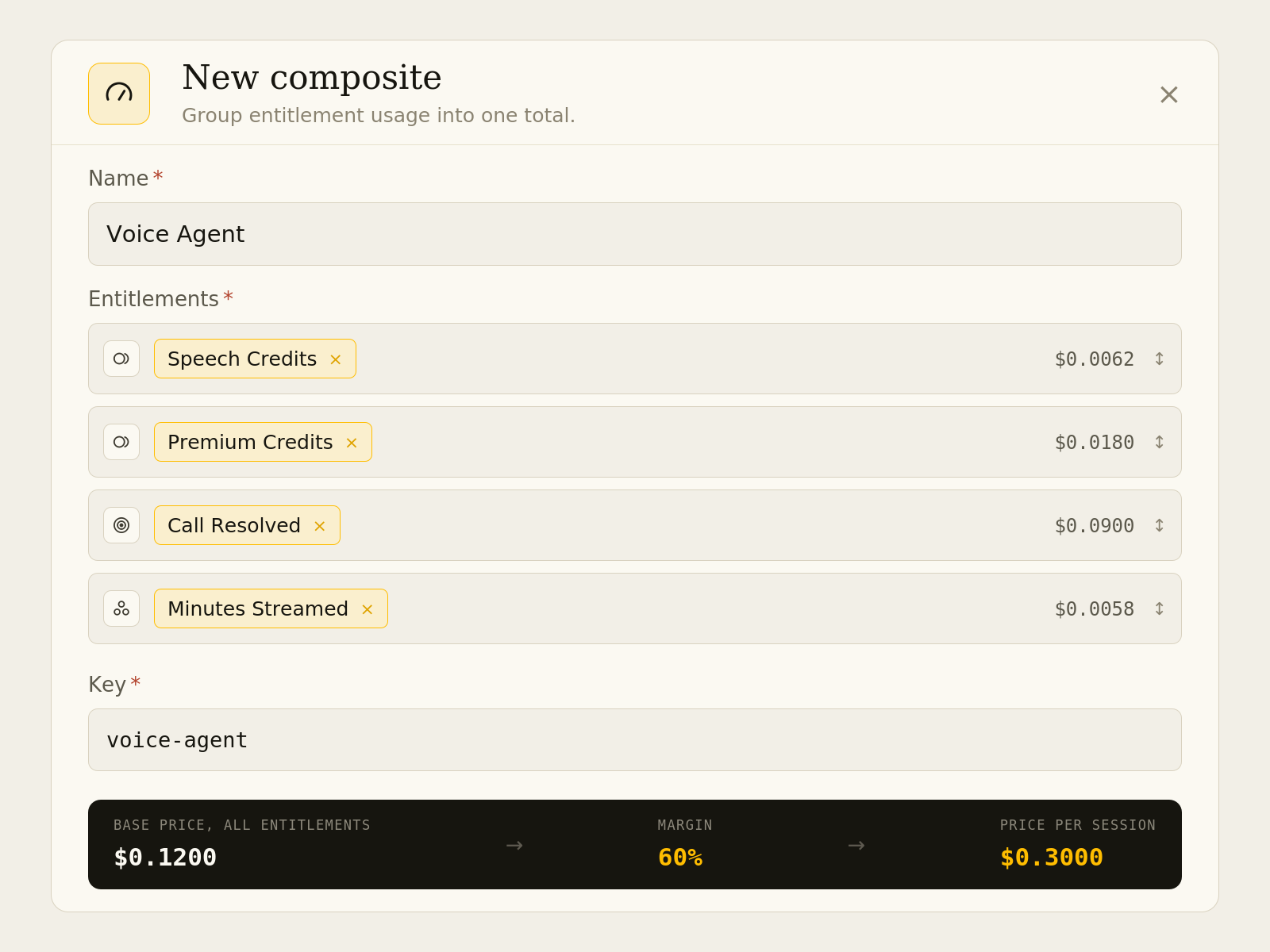
A composite combines multiple signals into one billable unit. You group the signals for an action, price them together into a single line item on an invoice for customers.
Composition
One customer-facing action can run on several subagents, each on its own model with its own token rate. A composite groups them under a single name instead of making you configure and bill each one separately.
New composite
Composite key
agent-session
Subagents
4
Models in use
3
Active
Billed as
1 composite
Control
Bundling the invoice line doesn't flatten what sits underneath. Every subagent keeps its own model, token rate, and margin, so you can tune the expensive one without touching the rest.
Subagent margins
Classification
68% margin
Retrieval
55% margin
Generation
71% margin
Blended margin
64%
Clarity
The customer sees the action they took, not the machinery behind it. Four subagents across three models still arrive as one line, with the detail kept underneath for margin analysis.
Customer view
Subagents metered
4
Shown to customer
agent-session
Invoice lines
1 instead of 4
Four things it makes easier.
A consolidated line item for a single workflow keeps the invoice clean and tells the customer exactly what they're paying for.
Group the signals once and the bundle prices as a unit, rather than maintaining four separate rates that have to move together.
The underlying signals are still metered individually, so you still hold granular control over margin on each moving part.
Composites sit alongside credits, outcomes, and units in the same plan. Bundle where it helps and meter separately everywhere else.
Composites are part of a bigger platform designed to make AI billing a breeze.
Composites ship with Clocknext's other pricing primitives, ready to sit alongside wallets, credits, outcomes, and units in a single plan.