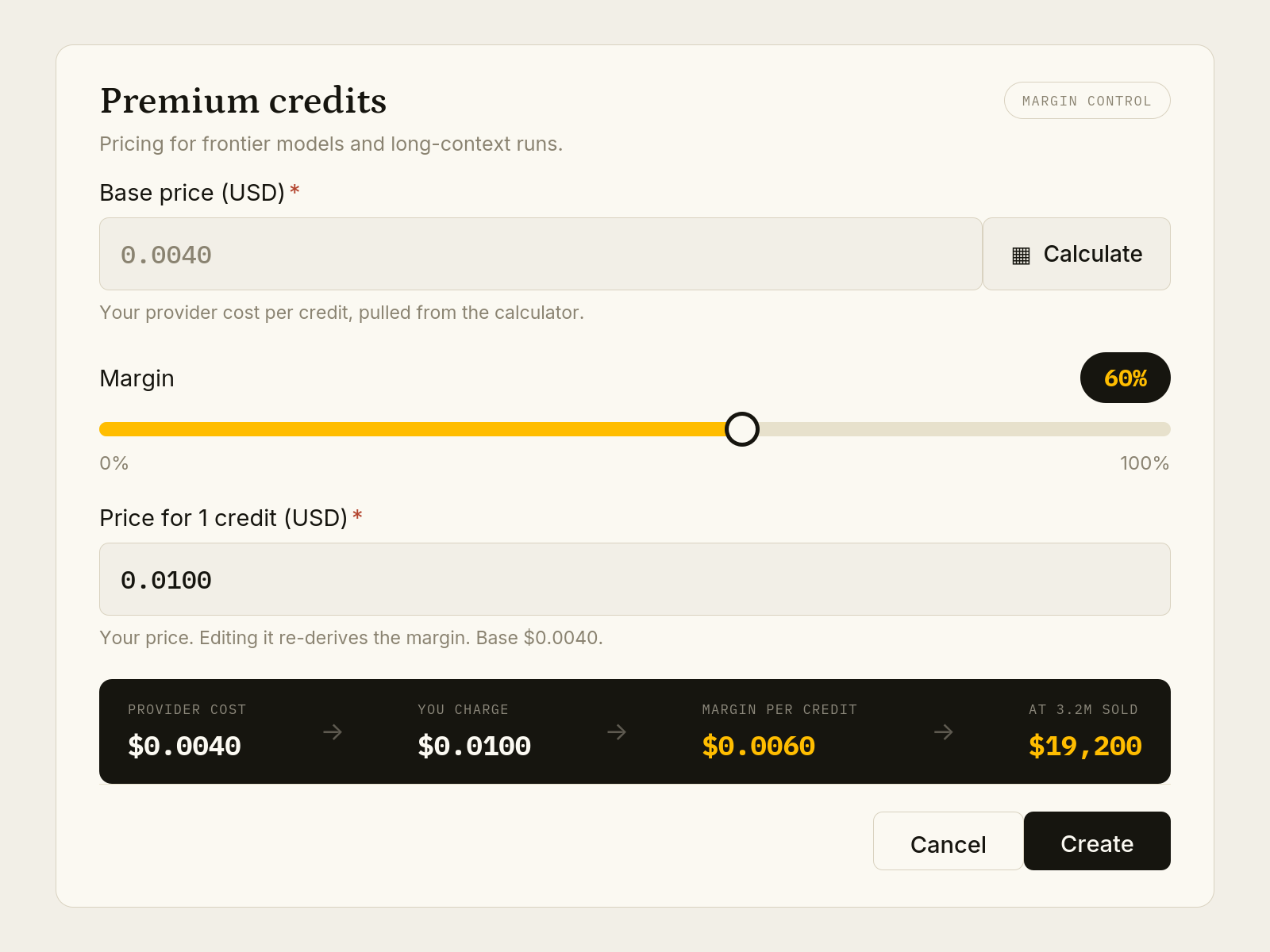
Margin control
Attribute provider cost to the signal that caused it. Know which offerings earn and which quietly lose money.

Every agent run costs you something at a provider before it earns anything from a customer. Clocknext attributes that cost to the same signal you billed for, so margin shows up per offering, per customer, and per invoice rather than at the end of the quarter.
Attribution
Record what a signal costs you at the provider alongside what you charged for it. The gap is your margin, visible on the same row rather than reconciled later.
Signal cost
Signal
agent.run
Charged
$0.0100
Provider cost
$0.0040
Margin per credit
$0.0060
Per offering
Line up every credit type, outcome, and bundle against its cost. The ones carrying the business and the ones dragging on it stop being a guess.
Margin by offering
Premium credits
60.0%
Standard credits
75.0%
Bulk credits
30.0%
Negative margin
When an offering is priced below what it costs to serve, it shows up flagged rather than buried. You see the revenue at risk and how many customers are on it.
Needs attention
Legacy bundle
-8.4% margin
Customers affected
23
Flagged
Revenue at risk
$14,280
Four decisions that stop being guesswork.
Set a rate knowing what serving it costs, instead of picking a number and finding out next quarter.
A large customer on a thin offering can earn less than a smaller one. Revenue alone hides that.
You know how much room a deal actually has before you offer it.
Revenue and cost come off the same signal, so finance isn't stitching two systems together to agree on a number.
Margin control is part of a bigger platform designed to make AI billing a breeze.
Margin control ships with Clocknext's other primitives, working off the same signals you already meter.