
How outcome-based pricing works in 2026, explained
Outcome-based pricing charges customers only when an AI agent delivers a defined result. How it works, real examples, and the margin math vendors miss.

TL;DR
Outcome-based pricing charges only for confirmed results, such as a resolved support ticket. It lowers the buyer's risk and moves that risk to the vendor, who still pays provider cost on every failed attempt. Model your margin at low resolution rates before you set a price.
What is outcome-based pricing?
Outcome-based pricing charges customers only when a product delivers a specific, measurable result, such as a resolved support ticket or a qualified lead. If the result doesn’t happen, there’s no charge, so the vendor carries the risk. Seat-based pricing charges for access, usage-based pricing charges for activity, and outcome-based pricing charges for results.
AI agents made this model common in software. Buyers who have seen per-resolution pricing on support agents increasingly ask other agent vendors for the same deal. The catch sits with the vendor: you pay your model provider for every attempt your agent makes, and you get paid only for the attempts that succeed. Outcome-based pricing works when the outcome is easy to count and your margin survives the misses.
How does outcome-based pricing work?
Outcome-based pricing works by turning a business result into a countable billing unit, then charging only after that unit is confirmed. Four decisions define every outcome-based plan:
- The outcome: One countable result your end customer already tracks: a resolved conversation, a booked meeting, a recovered chargeback. It should read like a metric on their own dashboard.
- The success criteria: Written rules for what counts. They set a measurement window (how long you wait before the result is final), a baseline if the outcome is an improvement, and exclusions such as escalations to a human, abandoned sessions, greetings, and test traffic.
- Verification and attribution: Who confirms the result, from which system of record. When the result lives in the customer's CRM or helpdesk instead of your product, both sides agree in advance whose record counts.
- The billable signal: Your agent emits signals (metered events) as it works. The billable outcome is recorded only when the measurement window closes and the criteria pass. Confirmed outcomes multiplied by the price per outcome make the invoice.
A support agent is a stellar example that shows how the pieces fit: the agent closes a ticket on Monday. Zendesk, for example, ends an email conversation 72 hours after it starts and a messaging conversation after 2 hours by default, and only then counts a verified resolution (Zendesk help). If the end customer reopens the ticket on Tuesday or asks for a human, nothing is billed. If the ticket stays closed through Thursday, one outcome is billed.
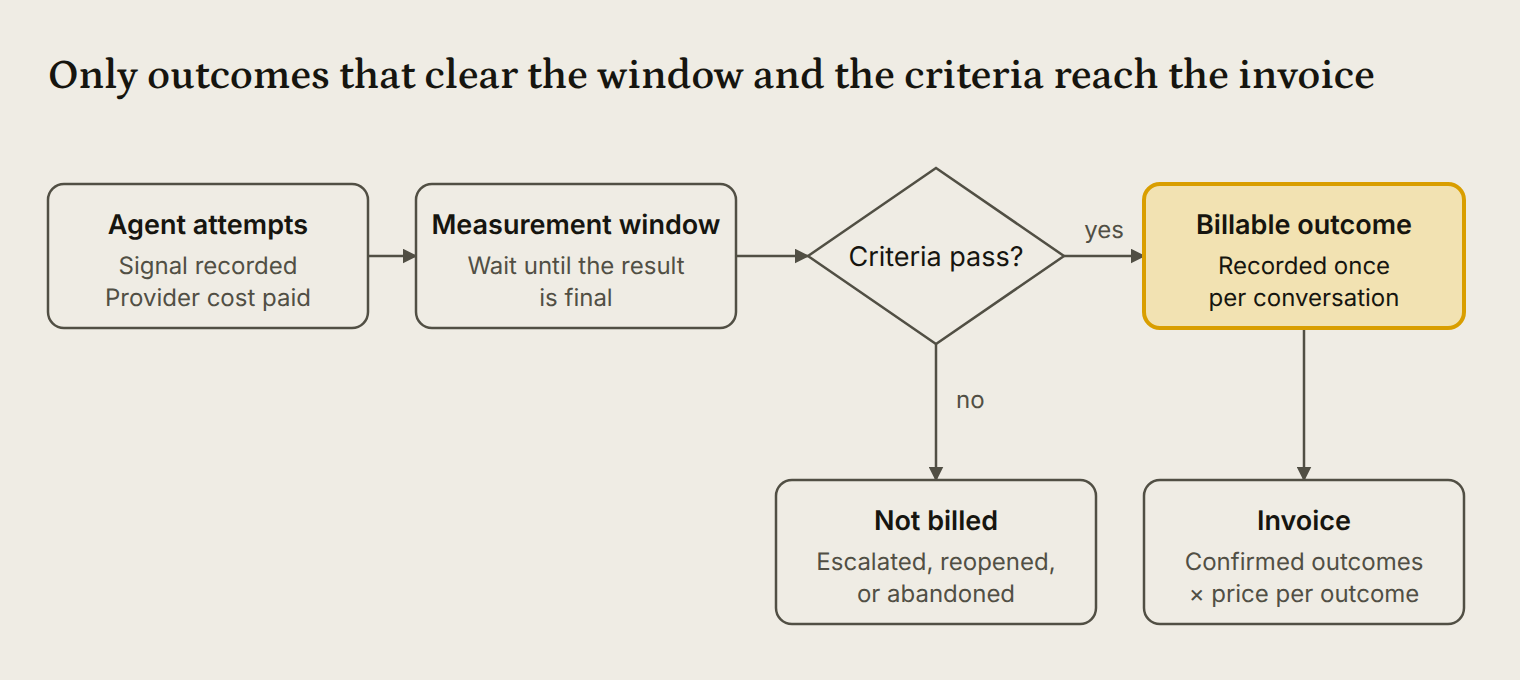
Provider cost is paid at the first step, before anyone knows whether the attempt will be billed. Every attempt that ends on the "not billed" branch is a cost the vendor absorbs.
Outcome-based pricing vs usage-based, seat-based and value-based pricing
Outcome-based pricing differs from the other models in one place: the charge waits for a confirmed result. That single change moves the risk, the revenue profile, and the margin exposure.
Value-based pricing decides how much to charge. Outcome-based pricing also decides when the charge happens, which is why it is often described as the strictest form of value-based pricing.
Many plans sold as outcome-based are usage-based pricing with an outcome label. The SaaS CFO offers a fast test: finish the sentence "The customer pays only when ___." If the blank describes product activity, such as a message sent or a workflow run, the plan is usage-based. If it describes a result the customer already reports on, such as a ticket resolved without a human, the plan is outcome-based.
Most real plans are hybrids. A platform fee, a credit bundle, or a committed minimum sits underneath, and the outcome charge sits on top.
Outcome-based pricing examples in 2026
Outcome-based pricing is now standard for AI support agents, and it is spreading to sales, payments, and fraud. Prices below are as of October 2026, taken from each company's own pricing or help pages.
Support resolution dominates because it is binary, logged in one system, and easy to compare with the cost of a human agent. Almost every plan pairs the outcome charge with something steadier: a base plan, included credits, seats, or a per-conversation option. Outcome-based pricing also predates software: Rolls-Royce's "Power by the Hour" contracts have billed airlines per engine flying hour for decades.
What are the benefits of outcome-based pricing?
Outcome-based pricing lowers the risk of buying and gives the vendor a reason to keep improving the product. Both sides benefit, in different ways.
For the buyer:
- A lower barrier to adoption: A team that would not sign a six-figure subscription for an unproven agent will often trial a per-outcome plan.
- No shelfware: Spend tracks results, so an agent that sits idle costs nothing.
- An easy ROI case: Finance compares the price per outcome with the cost of the same outcome done by hand.
For the vendor:
- Upside when the product over-delivers: A flat fee caps revenue. Outcome revenue grows as the resolution rate grows.
- Shorter sales cycles for new products: The buyer's risk is small, so pilots start faster.
- Aligned incentives: Every improvement to the agent shows up on the invoice, which keeps product, engineering, and customer success working on the same number.
The margin problem: who pays for failed attempts?
Under outcome-based pricing, the vendor pays for failed attempts. Your model provider bills you for every conversation your agent handles, and your customer pays you only for the ones it resolves. The gap between those two numbers is your margin, and it moves with your resolution rate.
Two formulas describe it:
Cost per billed outcome = provider cost per attempt ÷ resolution rate
Margin per outcome = 1 − (cost per billed outcome ÷ price per outcome)
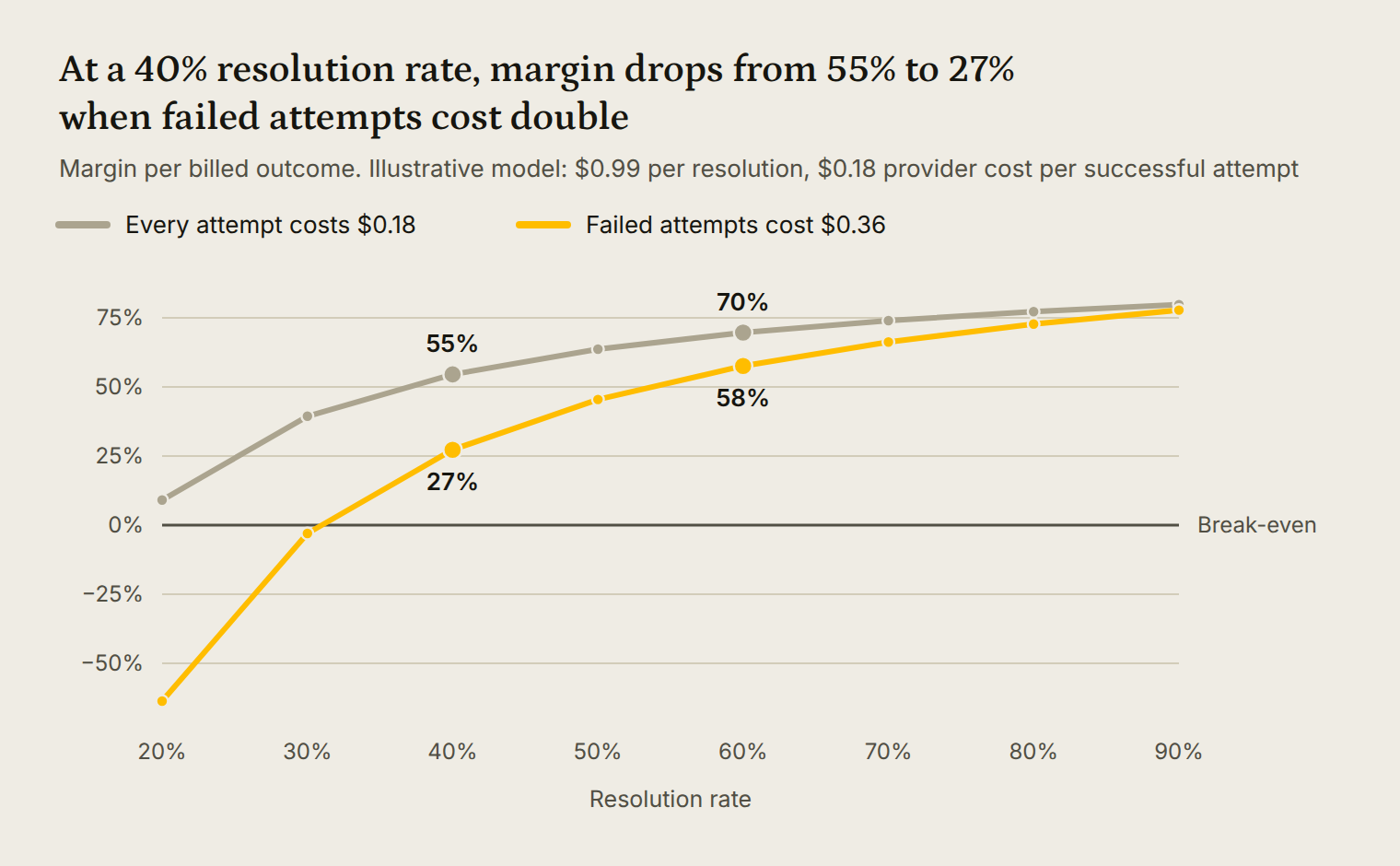
A worked example (illustrative numbers): Say you charge $0.99 per resolution and each conversation costs you $0.18 in provider cost.
- At a 60% resolution rate, each billed outcome carries $0.30 of provider cost. Margin is 70%.
- At a 40% resolution rate, each billed outcome carries $0.45. Margin falls to 55%.
The price is identical in both cases. Two customers on the same plan can land 15 points apart because one has a cleaner knowledge base or simpler questions.
Failed attempts are also rarely average. The conversations your agent cannot resolve tend to run longer, retry tools, and call bigger models. If a failed attempt costs twice as much as a successful one ($0.36 instead of $0.18), margin at a 60% resolution rate drops from 70% to 58%. At 40%, it drops to 27%.
What to measure before you set the price:
- Provider cost per attempt, per customer, per agent, and per model, including retries and tool calls. (A relevant read: How to track LLM costs per customer.)
- Provider cost split between attempts that resolved and attempts that did not.
- Resolution rate per customer, and how it changes in the first 90 days after onboarding.
- Cost per billed outcome per customer, compared against the price per outcome.
Set the price from the value of the outcome to the buyer. Then check it against the cost per billed outcome at the lowest resolution rate you expect to see. If the price fails that check, add a floor: a platform fee, a minimum commitment, or a per-conversation option for low-resolution workloads.
What are the challenges of outcome-based pricing?
The main challenges of outcome-based pricing are disputes over what counts, attribution, revenue volatility, and the accounting that follows. Margin, covered above, is the one most vendors find last.
- Definition disputes: Is a conversation resolved if a frustrated end customer stops replying? Every gray case becomes an invoice line someone can challenge. Vague definitions turn billing into negotiation.
- Attribution: The result your buyer cares about often lives in their CRM, helpdesk, or data warehouse. When a sale touched your agent, a campaign, and a human rep, the contract has to say which one gets the credit.
- Revenue volatility: Outcome volume moves with your customers' seasons, launches, and support backlogs. Forecasts turn into ranges.
- Budget anxiety on the buyer's side: If the agent works well, the bill grows fast. Buyers ask for caps, alerts, and committed-volume discounts before they sign.
- Revenue recognition: The work happens now and the outcome may be confirmed days later, sometimes after a plan change or cancellation. Finance needs written rules for which price applies and when revenue is recognized.
- Investor expectations: Investors are used to annual recurring revenue (ARR) from subscriptions. Outcome revenue needs a clear story: committed minimums, outcome growth per customer, and net revenue retention.
How to implement outcome-based pricing
Implementing outcome-based pricing takes seven steps, and most of the work happens before the first invoice.
- Pick an outcome that passes a dispute test: Would you, your customer, and your billing records agree it happened at least 95% of the time? If not, tighten the definition or price that workflow on usage.
- Write the success criteria and a "you're not charged when" list: Publish the measurement window, the exclusions (escalations, abandoned sessions, greetings, test traffic), and the refund rule for reopened outcomes.
- Instrument signals and the confirmation step: Record each attempt as a signal with its customer, agent, model, and provider cost. Record the outcome only when the window closes and the criteria pass, and keep the raw events for disputes.
- Model margin before you announce a price: Run the formulas above at your best, typical, and worst resolution rates, with failed attempts costed separately.
- Choose the commercial structure: Pure outcome pricing, a platform fee plus outcomes, prepaid credits that draw down per outcome, or a choice between per-conversation and per-resolution pricing.
- Add spend controls: A usage dashboard, monthly caps, threshold alerts, and committed-volume discounts answer the budget question before procurement asks it.
- Pilot, then publish: Start with a few customers, compare billed outcomes with their own records, and fix the definition before you roll out. Give every customer an auditable usage report: outcome ID, timestamp, criteria met, verification method, amount charged.
When is outcome-based pricing the wrong fit?
Outcome-based pricing is the wrong fit when the result is subjective, shared, or slow to appear. Three patterns signal it:
- Your agent produces many kinds of results: A workflow agent that writes reports for one team and updates records for another has no single outcome to price.
- Your agent is one contributor among several: If a booked meeting also depends on the customer's reps and campaigns, every invoice invites an attribution argument.
- The result lands weeks later: Revenue recovered next quarter or a renewal saved next year makes billing, cash flow, and revenue recognition hard for both sides.
In these cases, many vendors price on a usage proxy close to the result and report the outcomes alongside it. Decagon offers per-conversation pricing next to per-resolution pricing for this reason: it keeps the bill predictable and removes arguments over what a resolution is. Usage pricing with outcome reporting is a legitimate design, as long as the plan is described honestly.
Price outcomes without guessing your margin
Clocknext gives you margin visibility per customer, per agent, and per model, so you know what each billed outcome costs before you set its price. Outcomes are one of the pricing primitives you combine in a single plan with credits, units, wallets, and flat fees, so a platform fee and a per-resolution charge live in the same plan. Billing in advance or in arrears is set per entitlement, so a prepaid credit bundle and an outcome charge billed after confirmation can sit side by side.
Talk to us about pricing your agent on outcomes.
Top picks at a glance
Tool
Best for
Why it fits
Frequently asked questions
Is outcome-based pricing the same as success-based pricing?
The two terms are often used interchangeably. Both tie payment to a result. In practice, success-based pricing usually describes one-off fees for a milestone, such as a recruiter's placement fee or a consultant's completion bonus. Outcome-based pricing usually describes a recurring per-result charge in software, such as a price per resolved support conversation.
Is outcome-based pricing the same as output-based pricing?
Outcome-based pricing charges for a result the buyer wanted. Output-based pricing charges for what the product produced, whether or not it achieved that result. A drafted email reply is an output. A support ticket closed without a human is an outcome. Output-based pricing behaves like usage-based pricing, with the vendor carrying far less risk.
What is the difference between outcome-based pricing and value-based pricing?
Value-based pricing sets the price level from the value a buyer expects to get, often as a flat fee paid up front. Outcome-based pricing charges only after a defined result is confirmed. That makes outcome-based pricing a stricter form of value-based pricing: the vendor proves the value before it gets paid.
Is per-resolution pricing outcome-based pricing?
Per-resolution pricing is outcome-based when a resolution has written criteria, such as no human involvement and no reopening within a set window. Per-conversation pricing is usage-based, because every conversation is billed. Salesforce sells both: $2 per Agentforce conversation and $2 per Help Agent resolution, as of October 2026.
Is outcome-based pricing only for AI products?
Outcome-based pricing is much older than AI. Rolls-Royce bills airlines per engine flying hour, performance marketers charge per lead or sale, and chargeback services take a share of funds recovered. AI agents made it practical for software because an agent logs every attempt and every result, which makes outcomes cheap to count.
How is revenue recognized under outcome-based pricing?
Outcome fees are usually treated as variable consideration under ASC 606 and IFRS 15, and are often recognized as outcomes are confirmed. Committed minimums, prepaid credits, and refunds for reopened outcomes each need their own treatment. The answer depends on your contract terms, so confirm it with your accountant before you launch.