
The real cost of building AI billing in-house
In-house billing is the right call for your first pricing model. Here is what it costs once pricing starts changing, and which parts of billing to keep.


Most AI companies build their first billing system themselves, and at the time it is the right call. You have one pricing model, a handful of customers, and an engineering team that already knows the product. A usage table, a job that totals it at month end, and a Stripe integration get you invoicing in a couple of weeks.
The decision looks different a year later. By then you have changed pricing several times, added credits or an outcome price, and signed a few enterprise contracts with terms nobody planned for. The billing system that took two weeks now takes a part of every sprint.
What building in-house gets right
Building billing in-house has three real advantages:
- You control the logic. Your pricing may depend on things only your product knows: which model served a request, how many agent steps it took, whether a task finished. When billing lives in your codebase, you can meter any of it.
- You own the data. Usage events stay in your own database, next to your product data. Finance, product, and engineering can query the same tables.
- You avoid a dependency. No vendor sits between your product and your invoice, and no vendor's pricing model limits yours.
Each of these is a reason to care about how billing works. None of them requires your team to write and maintain every part of it.
Where the cost shows up
The cost of an in-house billing system depends mostly on one number: how often your pricing changes. The data suggests it changes a lot.
Pricing changes are routine. PricingSaaS tracks 500 SaaS and AI companies and recorded more than 1,800 pricing and packaging changes in 2025, roughly 3.6 per company. Lovable made about one meaningful pricing update a month over the same year. A 2026 survey of 230 B2B software and AI companies found that three in four had changed pricing or packaging within the previous 12 months.
The models are getting more complex. In the same survey, the share of companies on hybrid pricing rose from 25% to 37% in a year. Credit models in the PricingSaaS index more than doubled in 2025, from 35 companies to 79. Each hybrid plan or credit system adds billing logic: balances, burn rates, rollover rules, and two billing timings in one invoice.
Maintenance takes a steady share of engineering time. In a 2025 KPMG technology survey, 55% of respondents said 20% to 40% of engineering time in the prior year went to fixing technical debt. That figure covers all systems. Billing is a likely place for that debt to build up, because pricing changes are often made under a launch deadline and every mistake reaches a customer's invoice.
What those changes look like
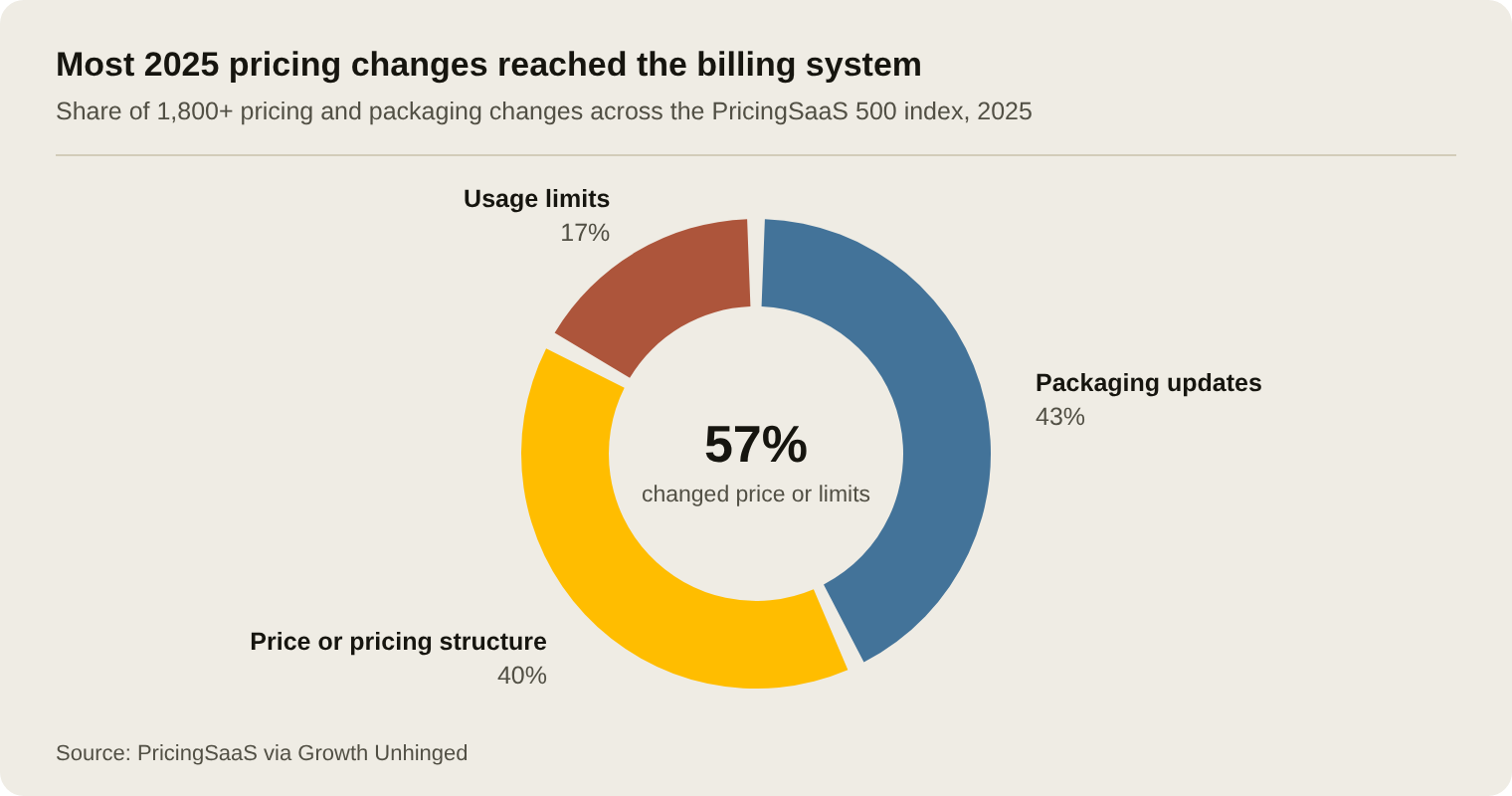
Packaging updates are the easiest to absorb, since they mostly move features between plans. The other 57% change what a customer is charged or how much they can use, and those land directly in the billing system: new rates, new meters, new limits to enforce, and customers on old plans who need to be moved or kept where they are.
How to keep control without owning every line
Most AI companies need to own three parts of billing.
- Keep the definitions. What counts as a billable event, what counts as a completed outcome, and how many credits each action consumes. These encode how your product creates value, and your team should decide them.
- Keep the data flowing from your product. Your application emits usage signals with the customer, agent, and model attached. That instrumentation belongs in your codebase, because only your product knows those details.
- Hand off the machinery. Rating usage against plans, managing credit balances, handling billing in advance and in arrears, versioning plans, proration, and invoicing are the same problems at every company. They also need upkeep every time pricing changes.
List the last five pricing changes your team made and how long each took from decision to live. If most of that time went to billing code, the machinery is costing you speed on work that does not set your product apart.
Where Clocknext fits
Clocknext is built to be that machinery for AI companies. Unlike an in-house billing system, Clocknext sustains itself and constantly adds more capabilities to make your billing processes smoother. It's built to be flexible and adapt to your ideal pricing model, and scales gracefully as you break through customer and revenue milestones.
What this means for you is that your team can focus on the decisions that matter: what to charge for and how much. The rest runs outside your codebase, so the next pricing change isn't an engineering sprint, but a configuration update your team can ship the same week.
If you're tired of maintaining in-house billing systems, then you're in the right place. Talk to us; we'd love to help.
Manish Balaji
A fan of compelling stories, memorable product experiences, and Liverpool FC, not necessarily in that order.